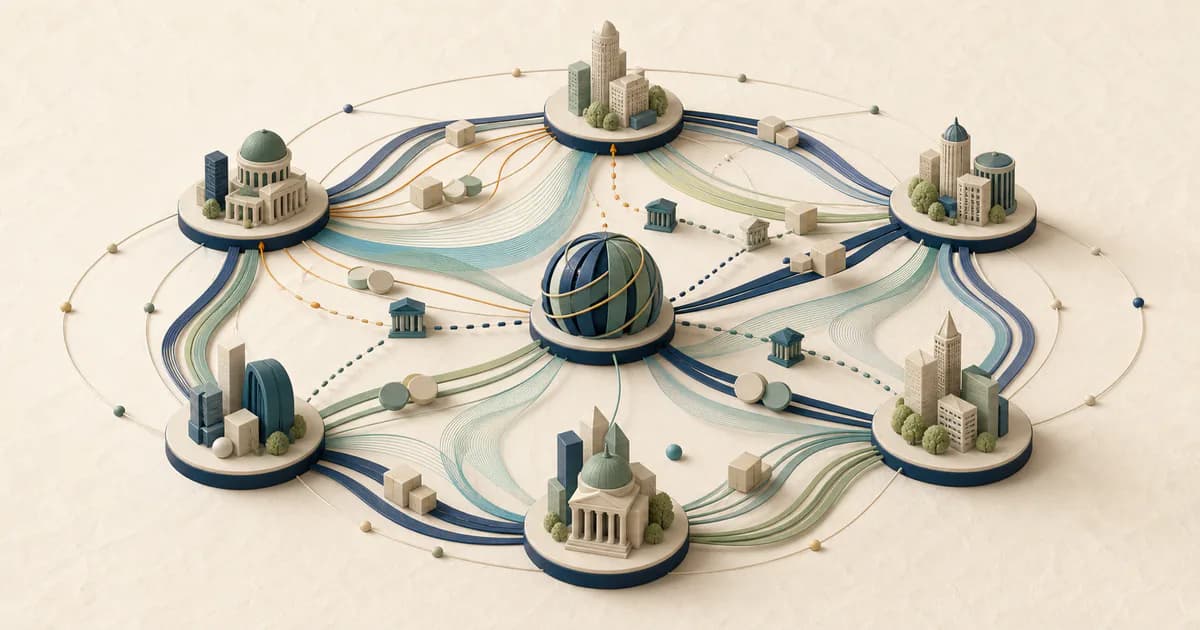
The global market is the connected system in which goods, services, capital, currencies and financial assets move across national borders. It is not one exchange or website. It is a network of businesses, consumers, governments, banks, investors, payment systems, ports, exchanges and rules that link national economies.
A local event can therefore have global effects: an energy shock can change transport costs and inflation; an interest-rate change can move currencies and capital; a tariff can alter supply chains; and a banking or market disruption can change risk appetite across regions.
Main types of global markets
| Market | What crosses borders | Example | Key variables |
|---|---|---|---|
| Goods | Physical products and inputs | Semiconductors made in one economy and assembled into devices in another | Tariffs, freight, commodity prices, standards and exchange rates |
| Services | Transport, travel, finance, software, consulting and other services | A company buys cloud or design services from a foreign supplier | Data rules, licensing, tax, language and digital infrastructure |
| Capital | Direct investment, loans, bonds and equities | A fund buys another country's government bond | Interest rates, credit risk, capital controls, liquidity and currency |
| Foreign exchange | One currency exchanged for another | An exporter converts foreign sales into its home currency | Monetary policy, trade flows, intervention and market liquidity |
| Labor and knowledge | People, skills and intellectual property | A specialist works abroad or licenses technology internationally | Immigration rules, qualifications, contracts and IP protection |
The categories interact. A goods shipment creates payment and foreign-exchange flows. A foreign factory combines direct investment, local labor, imported machinery and future trade.
Global trade in goods and services
The WTO provides the rules framework and official data for trade in goods and services. Services include transport, finance, tourism, telecommunications and digitally delivered work. WTO materials note that services are also embedded in manufactured goods, so their contribution is larger when measured on a value-added basis than in conventional cross-border payment statistics.
Trade data can be reported as value, volume or share of GDP. A rise in dollar trade value can reflect higher prices or exchange rates rather than more physical goods. Compare the unit, period and revisions before drawing a conclusion.
Global financial and capital markets
Global capital markets connect savers and borrowers across borders through bank lending, bonds, equities, funds and direct investment. The IMF says capital flows can finance investment, diversify risk and improve allocation, but they can also reverse abruptly and amplify macroeconomic or financial stress.
For an investor, buying an international fund can add exposure to foreign companies, currencies, custody chains and local market rules. A fund traded in U.S. dollars can still carry foreign-currency risk because the underlying businesses earn and are valued in other currencies. Global diversification can spread issuer or country exposure, but it cannot eliminate market loss or guarantee that markets fall at different times.
How shocks travel through the global market
Four common transmission channels are:
- Prices: oil, food, metals and shipping costs affect production and inflation in importing economies.
- Interest and currency rates: policy changes alter borrowing costs, exchange rates and the relative appeal of assets.
- Supply chains: a factory, port or software disruption can delay inputs in several countries.
- Risk sentiment: investors may reduce exposure across unrelated emerging or risky assets during stress, tightening financial conditions.
The IMF's April 2026 Global Financial Stability Report emphasized that cross-border portfolio flows can offer opportunities while remaining sensitive to global risk sentiment. That is an assessment of transmission risk, not a forecast that every country or asset will move the same way.
Examples
Consumer electronics: design, chips, assembly, shipping, software and retail can take place in different economies. Currency and trade-policy changes affect the final price.
Cross-border services: a business can buy cloud computing, advertising or professional services digitally. The transaction may still face tax, data and licensing rules in more than one jurisdiction.
International bond investment: an investor may earn bond interest but lose in home-currency terms if the foreign currency falls. Credit, rate, liquidity and custody risks remain.
Commodity shock: a disruption in a major energy-producing region can affect global fuel, shipping, inflation expectations and interest-rate forecasts even in countries that do not trade directly with that producer.
How to read global-market claims
Ask:
- Does market mean goods, services, currencies or securities?
- Is the claim global, regional or based on a few large economies?
- Is the data nominal value, inflation-adjusted volume or a forecast?
- Which publication date and revision are being used?
- Does an index weight countries by market capitalization, output or equally?
- Are currency effects separated from local asset returns?
Current forecasts can legitimately differ because institutions use different data cutoffs and assumptions. Treat projections as scenarios, not measurements.
Bottom line
The global market is a system of linked real-economy and financial transactions, not a single stock exchange. Its main components are trade in goods and services, capital flows and currency markets. Understanding which component, unit and transmission channel a claim refers to is more useful than treating the global market as one price moving in one direction.